T-BANK
+20% conversion increase in club joining.
A loyalty club update that resulted in a 20% conversion increase in club joining.
September 2025
— My first task when I joined Tinkoff was redesigning the Loyalty Clubs feature. Loyalty Clubs are a product aimed at increasing repeat purchases from partner brands through gamification. After several repeat purchases of a partner brand (e.g., Coca-Cola), we invite users to join that brand’s club and receive higher cashback proportional to their spending on that brand.
SERVICES
product design


WHY TO REDO IT?
Loyalty Clubs were already an active and growing feature, but we aimed to make them even better. Additionally, user research revealed several UX issues that we wanted to address.
To better understand the problem, I started with a high-level overview of the entire user journey for joining a Loyalty Club. I reviewed existing research and analyzed available data to identify key patterns and areas for improvement.
Mapped the entire Loyalty Club enrollment flow starting from the entry point in the Tinkoff app to identify potential friction points and align the user journey with the analytical conversion funnel.
Approach

Flow of joining loyalty clubs
After mapping the flow, we realized that we could:
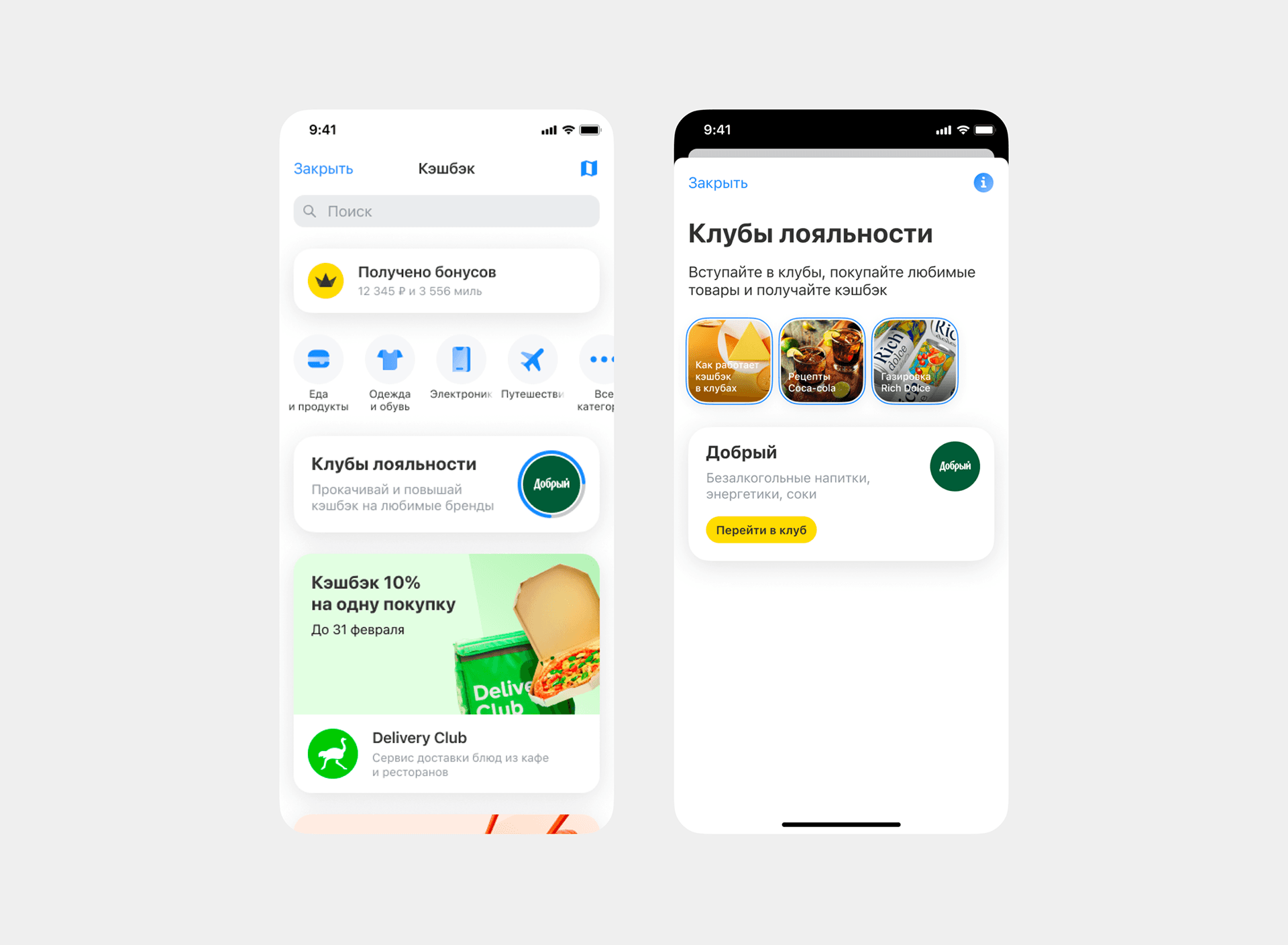
Improve the entry point card on the cashback and bonuses homepage by adding more contextual information. Simplify the onboarding flow in this section; currently it consists of five story-like screens with large blocks of text that users tend to skip. Make the CTA in the club card more intuitive. Right now, the button says “Go to club,” which duplicates the action of clicking the card itself and redirects users to the club page. The club card itself is not visually compelling enough to encourage users to join. On the clubs page, the maximum club level is hidden, which may reduce users’ motivation to join.
Analytics
To understand which stage of the loyalty club funnel is the weakest, we analyzed the metrics for each step of the flow mapped above. The funnel analysis showed that the weakest point was the loyalty club card itself, where drop-off rates reached up to 31%.

Research
A few months before I started working on the task, a qualitative study was conducted to understand how users interact with loyalty clubs. Here are some of the key insights uncovered during the research: - Respondents had difficulty finding the entry point to the section. We decided not to address this issue, since a full redesign of the section was already in progress and expected to solve it. - On the loyalty clubs home page, not all respondents clearly understood how the clubs worked or what their purpose was. - On the club page itself, respondents struggled to understand what the maximum level in the club was, and many did not realize that the levels carousel was horizontally scrollable.
Discovery Outcomes
After the discovery phase, we came up with many ideas on how to improve the loyalty clubs experience. We needed to visualize the hypotheses that emerged during discovery to make them easier to prioritize and discuss with the rest of the team. That’s what I focused on next. In total, we generated around 10 hypotheses. Here are some of them:
Hypotheses
Hypothesis 1
If we move the join button one step higher in the flow, we can increase the conversion to joining, because users will not need to go one level deeper in the flow.

Hypothesis 2
If we display the maximum cashback amount directly on the card, we can increase users’ motivation to join the club by immediately communicating its maximum value.

Hypothesis 3
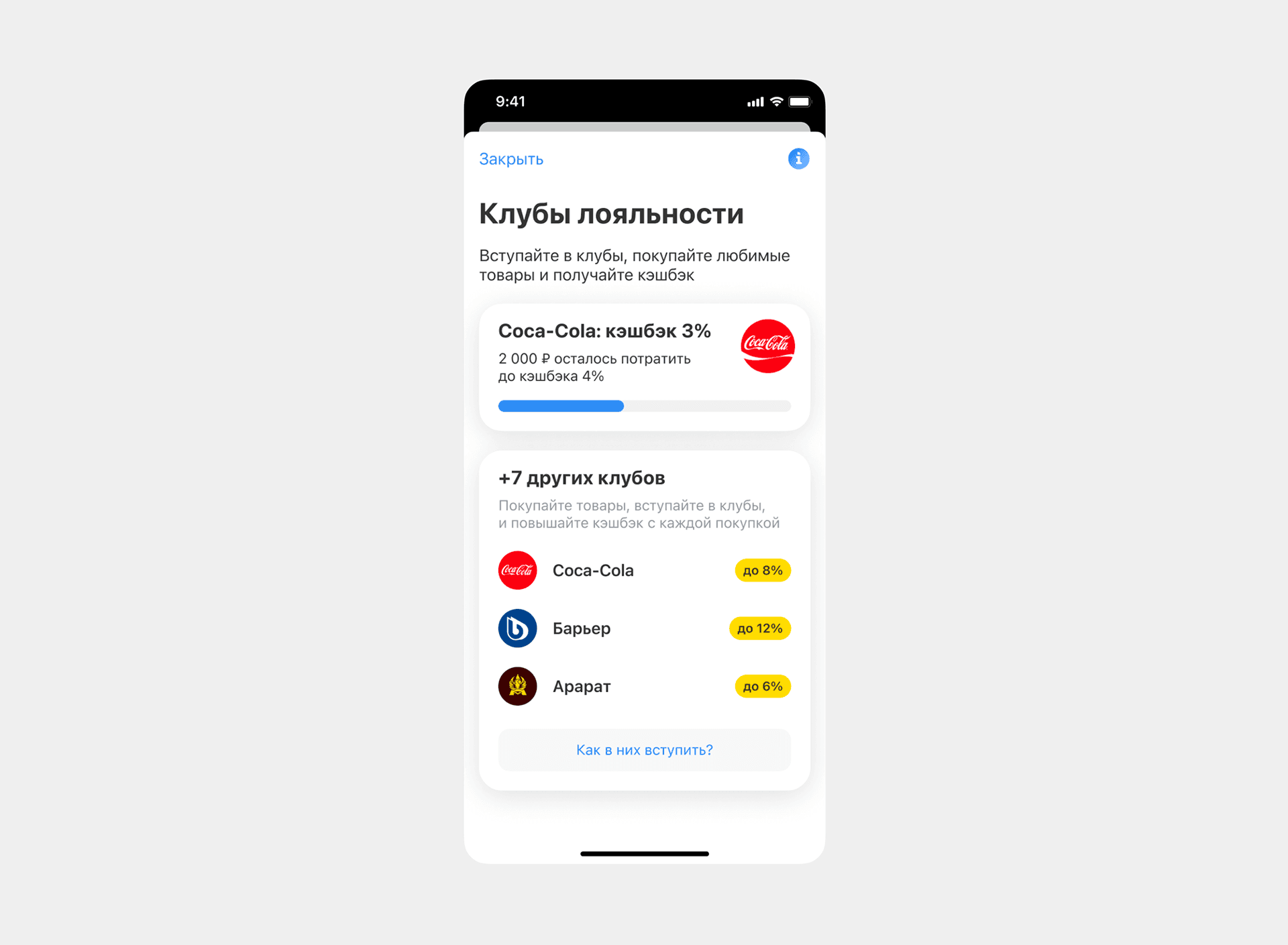
If we redesign the levels progress bar to clearly show the maximum cashback percentage from the start, we can increase transactional activity within the clubs by motivating users with the highest possible cashback reward.
Hypothesis 4
If we improve the clarity of the copy and visual design of the entry point, it will help better communicate the value of the loyalty clubs.
Hypothesis 5
If we explain why a user was offered a specific club, it will increase awareness by addressing the question: “Why am I seeing this?”

Hypothesis 6
If we show clubs that are not yet available to the user, it can increase transactional activity, as it creates a desire to reach rewards that are not yet accessible.
Hypothesis prioritization
We had many hypotheses for improving the loyalty clubs experience, but unfortunately it wasn’t possible to implement all of them at once. Therefore, together with the product team, we focused on prioritizing them. We prioritized the hypotheses based on implementation complexity and business value. Here is what we came up with:

Scoping
Together with the product manager, we selected 4 hypotheses that would directly impact the primary metric — conversion to club enrollment — as well as secondary metrics. The main hypothesis was moving the join action one step higher in the flow. This is a very simple change that is most likely to bring value to the business while also simplifying the user’s path to joining the club.

UX tests
There were many variations of the progress bar for the clubs screen. To make the selection of the format and design more objective, I gathered the best options and shared them in a dedicated UX testing channel to collect external feedback.

Final design
The loyalty club onboarding flow includes: the join button placed directly on the club card, a visual that provides context for the club’s theme, and the card’s state after the user has joined.

The updated loyalty club page features a new progress bar. After joining, the current level increases in size to clearly indicate the user’s current cashback status and highlight their progression within the club.

Design scope for both platforms: iOS and Android.

We also shortened the onboarding flow and rewrote the copy to make it more concise and easier to understand.

Release and test results
At the end of 2025, we launched an A/B test comparing the new loyalty clubs experience against the old one. After analyzing the results, we saw a +20% increase in conversion to loyalty club enrollment. We also positively impacted secondary metrics: +2.7% increase in turnover per customer within loyalty clubs +30% increase in cashback paid per customer within clubs

My role
- Framing and defining the problem - Discovery phase - Lo-fi design and hypothesis generation - Hypothesis prioritization and scoping in collaboration with the product manager - Hi-fi design, edge cases, animations, and prototyping - Collaboration with QA engineers during testing - Design review before release and logging design-related bugs - Post-release metrics review
What I would do next։ Loyalty clubs have strong potential for deeper gamification — including levels, rewards, and continuous user actions. The Hook Model could be applied to improve engagement and increase user retention over time. It would also be worth exploring integration of the clubs into the main cashback and bonuses feed, in order to increase the number of entry points into the experience. If I were working on this today, I would spend more time on discovery focused specifically on how to better gamify the product and drive sustained user engagement.